

Blog

Does Higher Specific Surface Area Always Mean Better MBBR Performance?
When engineers compare MBBR media, one specification usually attracts the most attention:
Specific Surface Area (SSA).
It is common to assume that a carrier offering 800, 900, or even 1,200 m²/m³ must perform better than one rated at 650 m²/m³.
At first glance, the logic seems simple:
More surface area = more biofilm = better treatment.
However, real-world wastewater treatment is far more complex.
The efficiency of an MBBR system depends not only on how much surface area is available but also on how effectively microorganisms can colonize, retain, and utilize that surface over years of operation.
What Is Specific Surface Area?
Specific Surface Area (SSA) represents the total surface available for biofilm growth within one cubic meter of MBBR media.
Manufacturers often use this figure as a key selling point because it is easy to compare.
But SSA alone does not determine treatment efficiency.
Several other factors are equally important.
More Surface Area Does Not Always Mean More Active Biofilm
The primary goal of MBBR media is not simply to maximize surface area.
The goal is to maximize effective biofilm activity.
Very high surface area designs often achieve impressive laboratory numbers by using:
- Extremely thin fins
- Narrow internal channels
- Dense internal structures
While these designs increase theoretical surface area, they may also create operational challenges.
Problems with Extremely High Surface Area Media
1. Reduced Water Circulation
When internal spaces become too narrow, wastewater cannot circulate efficiently.
Poor circulation limits:
- Oxygen transfer
- Nutrient transport
- Biofilm renewal
As a result, part of the available surface may become biologically inactive.
2. Excessive Biofilm Thickness
Biofilm naturally grows over time.
In carriers with very tight internal geometry, thick biofilm can partially block water flow.
This reduces oxygen penetration and creates inactive zones inside the carrier.
More surface becomes available on paper, but less remains active in practice.
3. Increased Risk of Clogging
Industrial wastewater often contains suspended solids, fibers, grease, or other contaminants.
Media with very narrow openings are generally more susceptible to fouling and clogging, which can reduce long-term performance.
4. Lower Mixing Efficiency
An effective MBBR system relies on continuous movement of the carriers.
Overly complex media geometries may experience less efficient mixing, reducing the natural scouring action that keeps biofilm healthy.
Why 650 m²/m³ Offers an Excellent Balance
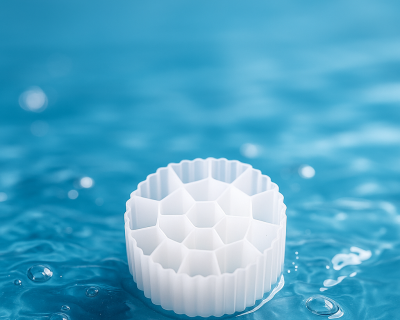
A well-designed 650 m²/m³ carrier provides an optimal balance between surface area and operational reliability.
Rather than maximizing theoretical numbers, this design focuses on maintaining effective biofilm activity throughout the life of the treatment plant.
Key advantages include:
- Excellent biofilm attachment
- Efficient water circulation
- Good oxygen distribution
- Stable biofilm thickness
- Strong resistance to clogging
- Reliable long-term performance
- Easy mixing inside the reactor
For most municipal and industrial wastewater applications, these characteristics are often more valuable than simply having the highest advertised surface area.
Active Surface Area Is More Important Than Total Surface Area
Another important concept is protected or effective surface area.
Not every square meter inside a carrier contributes equally to biological treatment.
The most effective biofilm develops on surfaces that are:
- Protected from excessive shear forces
- Continuously supplied with oxygen
- Exposed to flowing wastewater
- Easy for microorganisms to colonize
A carrier with a lower nominal surface area but a higher percentage of biologically active surface can outperform one with a much higher theoretical SSA.
Choosing MBBR Media Should Go Beyond One Number
When selecting biofilm carriers, engineers should evaluate several parameters together:
- Specific surface area
- Effective protected surface area
- Carrier geometry
- Material quality (Virgin HDPE)
- Density
- Mechanical durability
- Mixing performance
- Long-term operational stability
A balanced design usually delivers better lifecycle performance than one optimized for a single specification.
Conclusion
Specific Surface Area is an important parameter, but it should never be the only criterion when selecting MBBR media.
The highest published SSA does not automatically translate into the highest treatment efficiency.
For long-term operation, factors such as water circulation, oxygen transfer, biofilm stability, and carrier durability often have a greater impact on overall plant performance.
A 650 m²/m³ MBBR media offers a balanced combination of effective biofilm growth, hydraulic performance, and operational reliability, making it a dependable choice for a wide range of municipal and industrial wastewater treatment applications.