

Blog
MBBR Media Retrofit | Enke Group
Wastewater plants often hit a capacity wall. Flows increase, and new regulations arrive. However, building new tanks takes time and costs a lot of money. An MBBR media retrofit solves this problem without major construction. In fact, you simply add biofilm carriers to your existing tanks, and treatment capacity rises fast.
Enke Group designs MBBR media specifically for retrofit projects. Our carriers work inside your current basins, so there is no need to expand your footprint. As a result, plants can meet stricter discharge limits quickly and affordably. Additionally, installation causes minimal downtime.

How Does an MBBR Media Retrofit Work?
The process is simple. You add plastic biofilm carriers directly into an aeration tank. Bacteria then colonize the carrier surfaces. Meanwhile, your existing infrastructure keeps running during the upgrade. Therefore, the tank treats a higher load without adding volume.
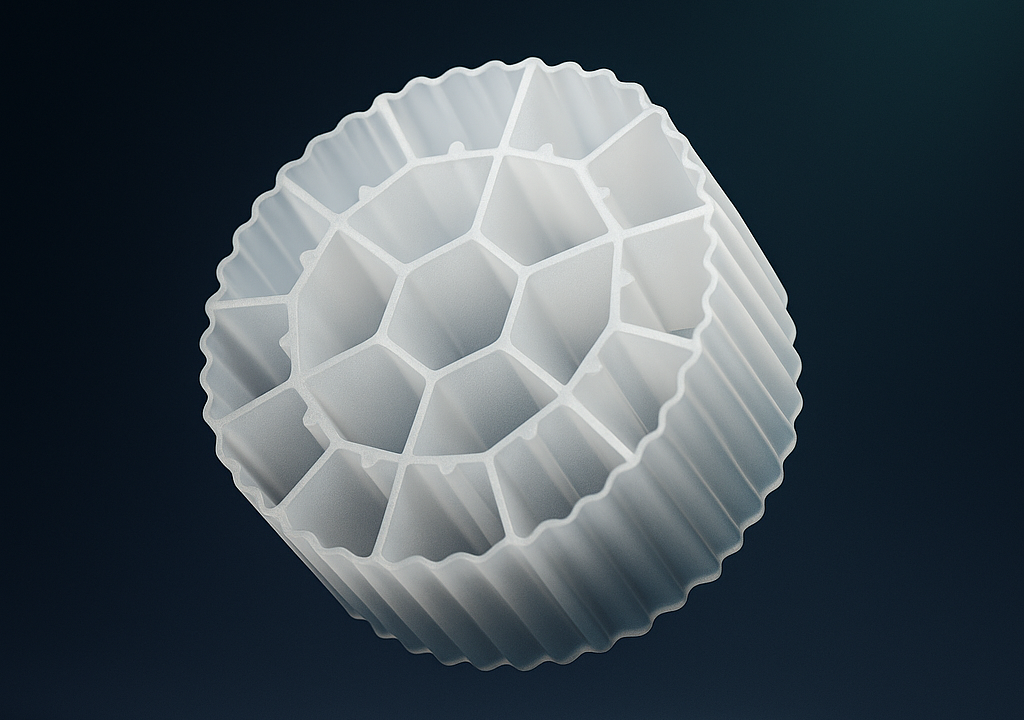
Enke Group carriers are made from virgin HDPE. This material resists cracking and UV damage. Furthermore, it holds up under years of mechanical stress. In addition, our chambered design gives bacteria more protected surface area than flat or ring-style carriers. This means faster biofilm growth and better removal rates.
Each carrier offers roughly 650 m² of protected surface area per cubic meter. This gives bacteria plenty of room to grow, even in tight tanks. Consequently, plants gain treatment capacity without losing hydraulic volume.
Sizing Your Retrofit Correctly
Retrofit success depends on the right fill ratio and carrier surface area. Every tank has different flow, load, and oxygen conditions. For example, a small municipal plant needs a different design than a food and beverage facility with high organic loads. Therefore, no two retrofit designs look exactly alike. Enke Group’s team reviews your tank data before recommending a solution. This step prevents under-sizing or wasted media.
Want more detail? Read our guide to MBBR media filling ratio and how it affects reactor performance.
Industries That Benefit from MBBR Retrofits
Many sectors choose an MBBR media retrofit. Food and beverage plants handle variable organic loads. Textile facilities manage color and chemical byproducts. Chemical and paper plants often need higher nitrification capacity. Meanwhile, municipal plants use retrofits to meet stricter ammonia limits. Overall, Enke Group’s HDPE carriers fit into existing tanks with minimal disruption.
Why Retrofit Instead of Building New Tanks?
An MBBR media retrofit offers several advantages over new construction:
- Lower capital cost than new civil construction
- Faster installation, often within days
- Higher capacity without a larger footprint
- Stable performance even during peak flows
- Compatible with most existing activated sludge tanks
These benefits make MBBR media retrofit projects popular across industries. Food and beverage, textile, chemical, and municipal plants all use this approach. Similarly, many aquaculture and paper mills add carriers to boost nitrification. In fact, the EPA’s technology review confirms reliable MBBR performance. This holds true across a wide range of applications.
Talk to Enke Group About Your Retrofit
Every retrofit project starts with a conversation. Our engineers assess your current tank and treatment goals. Then, we recommend the right carrier type, fill ratio, and installation plan. In short, you get a proven upgrade path without new construction. Contact Enke Group today to discuss your MBBR media retrofit. We typically respond within one business day.