

Blog
MBBR Media for Landfill Leachate | Enke Group
MBBR media for landfill leachate gives operators a robust way to treat one of the toughest wastewaters. Leachate is rich in ammonia and organic load. Moreover, its flow and strength change with every rain. Therefore, you need a biological process that stays stable when conditions swing.
Enke Group supplies virgin HDPE biofilm carriers built for this kind of hard duty. In this post, we explain why leachate is difficult and how our carriers help you meet discharge limits.
Why Landfill Leachate Is Hard to Treat
Leachate forms when rain soaks through waste and picks up pollutants. As a result, it carries high ammonia, dissolved salts and slowly degradable organics. In fact, ammonia levels in older landfills can exceed 1,000 mg/L.
The mix also changes as a landfill ages. Young leachate has a lot of easy-to-break-down organics. Old leachate, however, holds more ammonia and fewer simple organics. Consequently, one plant must often handle both types over its life.
Flow is another challenge. Heavy rain can double the volume in a few days. Dry seasons, on the other hand, bring low flows with very strong water.
How MBBR Media for Landfill Leachate Solves These Problems
In an MBBR, bacteria grow as a biofilm on moving carriers. The biofilm stays in the tank, even when flow rises. Therefore, a storm does not wash out your biomass.
This matters most for nitrifying bacteria. They grow slowly, and activated sludge can easily lose them. On carriers, however, they build up and stay put. As a result, ammonia removal stays steady through load peaks.
The biofilm also has layers. Outer layers handle organics first, while inner layers protect sensitive nitrifiers. In addition, this structure gives some buffer against toxic shocks from salts or metals.
Key Features of Enke Group Carriers
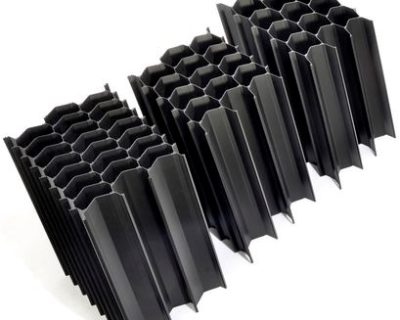
We build our MBBR media for landfill leachate and other harsh water. Here is what sets it apart:
- Virgin HDPE: resists chemicals, salts and constant movement without cracking.
- Protected chambers: shelter the biofilm from shear, so nitrifiers stay in place.
- High protected surface area: holds more bacteria in a smaller tank.
- Stable density: keeps the carriers moving evenly with air or mixers.
Because of this, you can treat strong leachate in a compact reactor. That is a real benefit at landfill sites, where space and budgets are often tight.
Designing a Leachate MBBR Plant
A typical design starts with an equalization tank. It smooths out the swings in flow and strength. Next, aerobic MBBR stages remove organics and convert ammonia to nitrate. Finally, an anoxic stage can remove nitrate if total nitrogen limits apply.
Many sites also add a polishing step. For example, MBBR effluent can feed membranes or reverse osmosis. In this case, the MBBR lowers the load and protects the membranes from fouling.
Leachate is often low in carbon and phosphorus. For this reason, you may need to dose an external carbon source or nutrients. Similarly, check alkalinity, since nitrification consumes it quickly.
If your leachate also contains industrial chemicals, read our guide on MBBR media for chemical wastewater treatment. For background on landfill rules, see the US EPA landfill resources.
Why Choose Enke Group
We do more than ship carriers. Our engineers review your leachate data and help size the reactor and fill ratio. Moreover, we support you from startup to steady operation.
Ready to upgrade your leachate treatment? Contact Enke Group today. We will help you pick the right MBBR media for landfill leachate and meet your discharge limits with confidence.