

Blog
MBBR Media for Dairy Wastewater | Enke Group
Dairy plants produce some of the strongest wastewater in the food sector. Milk, whey, cream and cleaning chemicals all end up in the drain. For this reason, MBBR media for dairy wastewater has become a popular choice for plant owners who need stable results. In this post, we explain why it works and how Enke Group carriers help.
Why Dairy Wastewater Is Hard to Treat
Dairy effluent is rich in lactose, proteins and fats. As a result, its COD and BOD levels are often many times higher than domestic sewage. Moreover, the load changes from hour to hour.
Cleaning-in-place (CIP) cycles add another challenge. For example, caustic and acid rinses can swing the pH sharply within minutes. Similarly, weekend shutdowns and seasonal milk peaks change the flow. A conventional activated sludge plant often struggles with these shocks. Also, bulking sludge and poor settling are common complaints from operators.
How MBBR Media for Dairy Wastewater Solves the Problem
An MBBR keeps the bacteria on plastic carriers instead of in loose flocs. Therefore, the biomass stays inside the tank, even when the load jumps. A sieve at the outlet holds the carriers back, while clean water flows on.
This fixed biofilm brings clear benefits for dairy sites:
- Shock tolerance: The thick biofilm absorbs sudden COD peaks and pH swings from CIP cycles.
- No sludge return: In fact, the process needs no return sludge line, so operators have less to manage.
- Compact tanks: High biomass per cubic metre means a smaller reactor for the same load.
- Easy expansion: Moreover, you can add more carriers later as milk volumes grow.
In short, the process stays steady when the factory does not. You can read more about similar plants in our guide to MBBR media for food and beverage wastewater.
Why Choose Enke Group Biofilm Carriers
Not every carrier performs well in a fatty, high-strength stream. Enke Group makes its MBBR media from 100% virgin HDPE. Consequently, the carriers resist caustic and acid cleaning agents and keep their shape for many years.
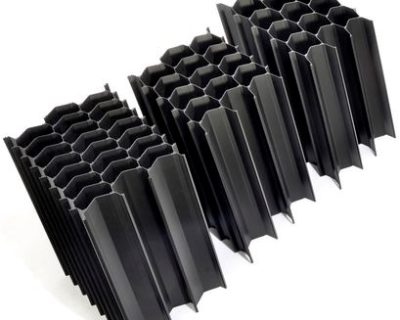
Our carriers also use a multi-chamber design with a large protected surface area. Thanks to this geometry, the biofilm grows inside the chambers, safe from abrasion. At the same time, the open structure lets oxygen and food reach the bacteria. As a result, removal stays high without clogging.
Additionally, the carriers have a density close to water. They move freely with gentle aeration, which keeps energy use low. Every batch also passes quality checks before it leaves our factory.
Design Tips for Dairy MBBR Plants
A good dairy MBBR starts with good pre-treatment. First, remove fats and solids with screening and a DAF unit. Next, use an equalization tank to smooth out CIP peaks and balance the pH.
After that, size the MBBR stage on the real COD load, not the average flow. Many plants choose a two-stage layout. The first reactor handles high-rate COD removal. Then, the second reactor polishes the effluent and, if needed, removes ammonia.
Finally, plan a sensible fill ratio. Most dairy reactors run with 40-60% media fill. This leaves room to add carriers when production grows. Our engineers can help you check these numbers for your site.
For wider technical background, see this overview of the moving bed biofilm reactor process.
Talk to Enke Group About Your Dairy Plant
Whether you run a cheese plant, a milk powder factory or a yogurt line, the right carrier matters. Enke Group supplies MBBR media for dairy wastewater projects of every size. Furthermore, our team supports you from sizing to start-up.
Contact Enke Group today to request a quote or a free technical review. Together, we can build a plant that meets discharge limits every day.