

Blog
MBBR Retrofit: Boost Plant Capacity | Enke Group

Your incoming load keeps rising. However, your aeration tank stays the same size. An MBBR retrofit closes that gap. In short, you add biofilm carriers to the tank you already own. As a result, you gain treatment capacity without pouring new concrete. Enke Group supplies the carriers that make this upgrade work.
What an MBBR Retrofit Actually Changes
A conventional activated sludge tank holds biomass in suspension. Therefore, its capacity depends on how much sludge the clarifier can handle. An MBBR retrofit adds a second home for bacteria. Carriers float in the same tank and hold a fixed biofilm. Consequently, total biomass rises sharply while sludge age stays stable.
The result is more treatment in the same volume. Moreover, the clarifier sees a similar solids load as before. In fact, many plants report calmer settling after the upgrade.
Why Plants Choose a Retrofit Over New Tanks
- Lower cost. Carriers cost far less than civil works.
- Faster start. Most projects finish in weeks, not seasons.
- No extra footprint. You use the basin you already have.
- Shock resistance. Fixed biofilm rides out load peaks well.
- Simple operation. Your team keeps the same daily routine.
Permits add another strong reason. For example, a tighter ammonia limit often arrives years before the budget for a new plant. In that case, a retrofit buys compliance quickly. Similarly, a seasonal load peak can be handled without a second line.
Where This Upgrade Works Best
Food and beverage plants see large swings in organic load. Textile and chemical sites face strong, variable effluent. Municipal works often need more capacity after new housing arrives. In all three cases, extra biomass solves the problem faster than extra concrete.
What Enke Group Carriers Bring to the Project
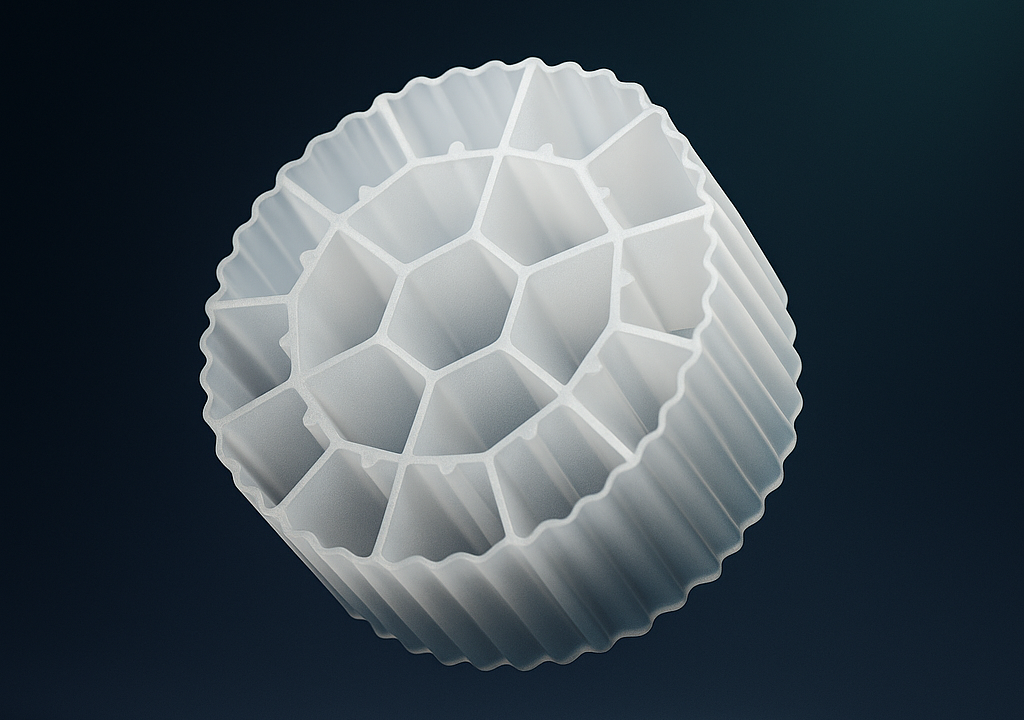
Success depends on carrier quality. Our MBBR media uses virgin HDPE, not recycled scrap. Therefore, the carriers hold their shape and density for years. The 19-chamber design shields the biofilm inside each wheel. As a result, shear from aeration does not strip the active layer.
Surface area matters just as much. Our carriers offer a high protected surface area per cubic metre. Consequently, you reach your target load with less media volume. Moreover, less media means less strain on screens and mixers.
Planning Your MBBR Retrofit Step by Step
Start with your current data. Measure flow, COD, ammonia and temperature over a full month. Next, set the treatment target you must reach. Our engineers then size the fill ratio for that target.
Most projects run between 30% and 60% fill. However, the right number depends on load and aeration capacity. Screens at the tank outlet keep carriers in place. In addition, the aeration grid may need a small redesign for even mixing.
For background on discharge rules, see the US EPA NPDES program. Furthermore, our guide on MBBR media cost explains the payback side in detail.
Talk to Enke Group Before You Build
A new tank is not always the answer. In many cases, a retrofit delivers the same result for a fraction of the cost. Send us your load data and tank dimensions. Our team will propose a fill ratio, a media quantity and a delivery plan. Contact Enke Group today and upgrade the plant you already own.